
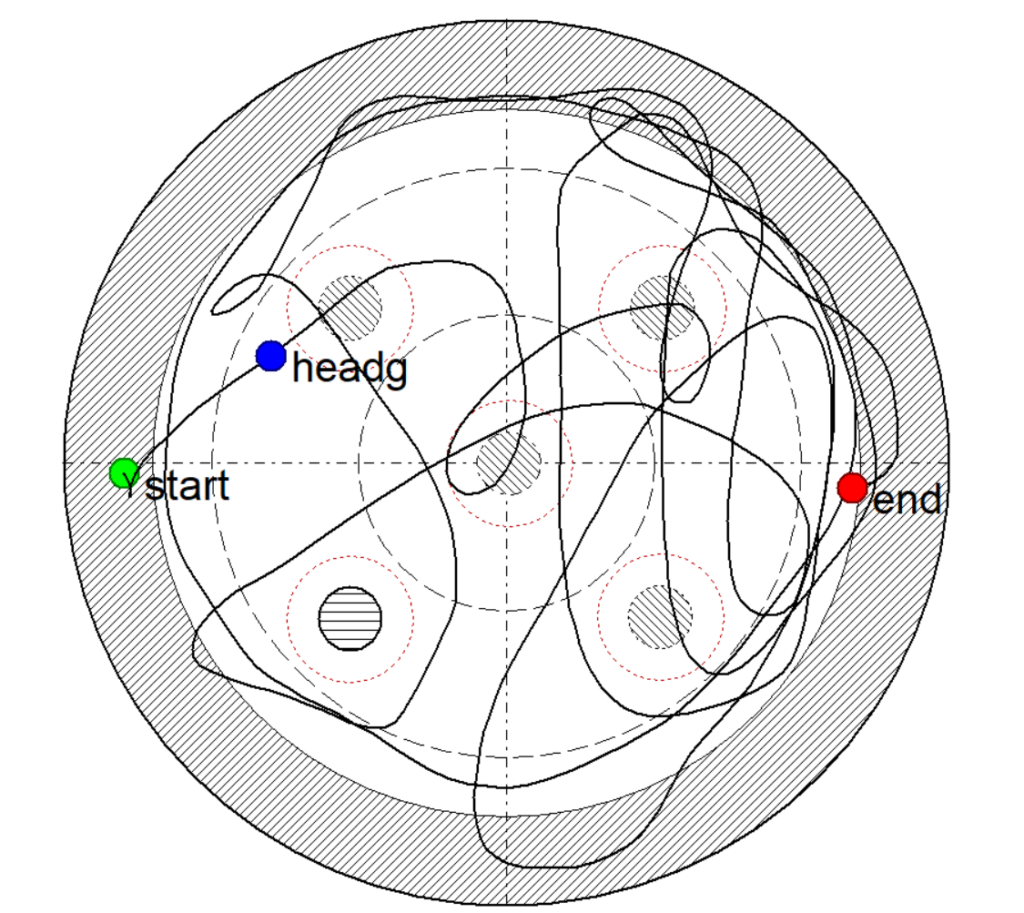
Heading angle, also known as heading error, is a measure of how directly the subject heads towards the escape platform or target location early in the trial. It indicates initial spatial intent, regardless of navigational follow-through.
It can be a useful measure in Morris water maze analysis, inndicating initial orientation accuracy in both acquisition and probe trials, particularly for:
- Revealing good but imperfect spatial learning and memory: if subjects head towards the exact location but just miss it, the heading angle will be very small, showing spatial intent even if other measures do not capture it.
- Revealing intact spatial memory when the subject sets off correctly but has a long latency or poor performance on conventional measures due to other factors such as slowness or distraction, e.g. in aging or disease models.
- Accurately measuring spatial memory in probe trials, when conventional measures such as time in target quadrant or platform crossings over the whole trial duration will be reduced for cognitively flexible subjects with the strongest spatial memory.
If heading angles decrease significantly over training trials but remain relatively large, this may or may not indicate developing spatial knowledge – see below.
The heading angle is the angle between a straight line from the start point to the platform or target location (the direct path), and a straight line from the start point to a point on the actual path after a certain distance has been traveled (the heading point, shown by a blue circle on HVS Image path plots). This distance is a percentage of the pool diameter, which can be adjusted to take account of experimental conditions and your own requirements. If, for example, subjects start the trial facing the pool center, a shorter distance can be used than if subjects start the trial facing the pool wall and need to turn before heading towards the target.
In probe trials, heading angles consistently close to zero for a group of subjects indicate strong spatial memory in that group, with subjects heading directly towards the target at the beginning of the trial; large or randomly scattered heading angles among a group suggest a lack of spatial memory in that group. In this case heading angle is superior to conventional measures such as platform crossings or time in the target quadrant, unless these are taken just for the first time slice of the trial, as subjects with both very strong spatial memory and cognitive flexibility will rapidly realise that the platform is no longer in the learned location and spend much of the trial searching elsewhere, reducing those conventional measures.
In learning trials, reducing heading angles that progress towards close to zero are a strong indication of spatial learning, and consistently large or random heading angles are a strong indication that spatial learning is not taking place (or if incidental, is not being used).
Consistent, indirect heading angles may indicate the use of procedural strategies (e.g. chaining).
Caveats
Reducing heading angles in learning trials that do not progress towards close to zero need to be interpreted in context and alongside other analyses, such as the path ratio or Gallagher proximity measures if spatial learning is suspected, or circling if chaining is suspected. If the platform is always on the side of the pool far from the start point, reducing heading angles that don’t progress towards close to zero may reflect a move away from thigmotaxis towards using the central area of the pool, but this may not be the case if the platform is close to the start point, when thigmotaxis could give a smaller heading angle than a path into the central area – this can be cross checked using the thigmotaxis measure.
Explore all Morris water maze analysis measures.