
Natural, embodied navigation for immersive VR experiments and rehabilitation.
At a glance
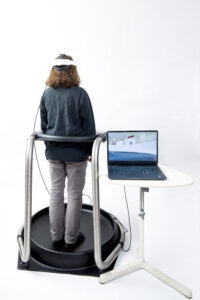
The Omnidrive omnidirectional treadmill allows participants to navigate virtual environments using their own physical movement, providing proprioceptive feedback that is absent in seated or controller-based tasks. Participants can move naturally within an unbounded virtual space, while occupying approximately a one-metre diameter area in the real world, enabling realistic navigation without requiring large physical rooms.
The system is quiet, stable, and suitable for a wide range of users, including those with balance or mobility difficulties, and proven over thousands of sessions in hospitals and universities.
Why physical movement matters in VR
Proprioceptive feedback and embodied navigation
In many VR tasks, participants remain seated and navigate using a joystick, keyboard, or controller. While convenient, these approaches remove proprioceptive and locomotor feedback, fundamentally changing how the brain processes movement and space.
Using an omnidirectional treadmill allows participants to move through the virtual environment using their own bodily movement, generating proprioceptive input from the legs and trunk and integrating this with visual and vestibular information.
From a neuroscience perspective, this is important because spatial navigation, memory, and motor planning rely on multisensory integration, particularly within hippocampal, parietal, and motor networks. Tasks performed while physically moving are therefore closer to real-world navigation than seated or controller-based equivalents.
Scientific advantages over seated or controller-based tasks
Compared with seated VR or joystick navigation, use of the omnidirectional treadmill:
- Preserves proprioceptive feedback, which influences spatial learning and memory
- Reduces reliance on abstract motor mappings (e.g. thumbsticks or buttons)
- Encourages natural coordination of egocentric and allocentric spatial processing
- Engages motor planning and sensorimotor prediction more fully
- Improves ecological validity for translational, clinical, and rehabilitation studies
These advantages are particularly relevant for spatial navigation tasks (such as virtual Morris Water Maze paradigms), cognitive–motor dual-task studies, aging and anxiety research, and rehabilitation contexts.
Unlimited virtual movement within minimal physical space
A key advantage of the VR treadmill is that it allows participants to:
- Walk naturally through large or infinite virtual environments
- While remaining within a small physical footprint (approximately one metre in diameter)
This removes the need for large tracking spaces, redirected walking techniques, or frequent stopping and repositioning, while preserving the experience of continuous, self-generated movement.
Participants experience natural locomotion in VR without physical space constraints in the laboratory or clinic.
Designed for safety, comfort, and accessibility
Stable stepping rather than sliding
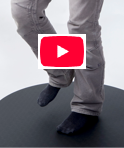
We use a step-up / step-down walking action, rather than low-friction sliding. This provides stable, predictable foot placement and reduces the feeling of instability that some users experience on ‘slidemills’.
You or your participants can choose the most suitable action:
- Wearing soft shoes, taking larger or smaller steps up and down
- As above but wearing socks
- Wearing socks and shuffling gently – may be more suitable for participants with limited mobility or balance
This flexibility makes the system suitable for:
- People with balance difficulties
- Older adults
- Rehabilitation patients
- Participants unfamiliar with VR
Quiet operation
Unlike other VR treadmills, the Omnidrive is silent other than the participant’s footfalls, reducing distraction and supporting focused cognitive performance. It’s therefore suitable for use in:
- Cognitive neuroscience laboratories
- EEG and physiological recording setups
- Clinical and rehabilitation environments
- Shared research spaces
Integrated safety rail
The treadmill includes a circular safety rail that surrounds the participant.
- The rail opens to allow easy entry and exit
- Participants are encouraged not to hold the rail during normal use
- If a participant becomes unsteady, they can immediately hold the rail for support
- The rail provides a clear physical boundary, increasing confidence and safety
This design supports natural movement while providing reassurance for participants who may feel uncertain.
Proven in real-world use
The Omnidrive VR treadmill has been used in thousands of sessions, and is a mature, reliable system suitable for routine use in research and applied settings.
Seamless integration with VR experiments and rehabilitation tasks
The Omnidrive integrates seamlessly with HVS Image’s fully immersive VR environments and task scripting system, allowing researchers and clinicians to combine natural locomotion with precisely controlled experimental or therapeutic protocols.
It is suitable across spatial navigation tasks, cognitive neuroscience experiments and rehabilitation applications, and can be combined with additional inputs such as EEG, physiological monitoring, or adaptive task control.