
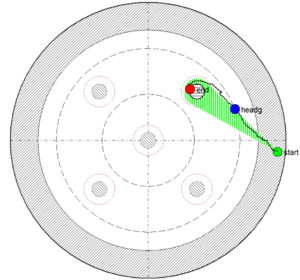
The cone test is a measure of goal-directed behaviour.
It shows the percentage of the trial time that the subject spent in a cone-shaped area that starts at the first point of the path and broadens towards the target platform position, with a total angle of 15 degrees. It therefore captures cases where a subject heads towards the target position, but not necessarily directly towards its centre.
Because a given angular error leads to a larger lateral deviation over a longer start-to-target distance than over a shorter one, actually reaching the platform or its counter is more challenging from more distant start points. Alongside the close encounter measures, the cone test provides a complementary measure that is comparable across different start-to-target distances.
If selected, the percentage time and path within the cone are given in your results, and the cone itself is shaded on path plots to highlight navigation towards the platform or learned position.
Understand the complete set of Morris water maze measures and analyses.