
As well as providing detailed analyses and raw data, HVS Image automatically identifies defined patterns of navigation and search in both rodent water maze and human virtual reality water maze. This can help distinguish different ways in which similar overall performance was achieved, and reveal key behaviors that whole-trial measures may obscure.
Several location-related behaviors can be analysed not only in relation to the current target in acquisition trials and the learned location in probe trials, but also to previous target positions and other calibrated locations. This can be particularly useful in reversal learning and cue-conflict or dual-strategy trials, where subjects may navigate towards more than one learned or experimentally relevant position. Applying the same criteria at each location can show which location is guiding navigation or search, how this changes during the trial or across learning, and help identify allocentric vs egocentric learning, and perseverence vs cognitive flxibility, for example.
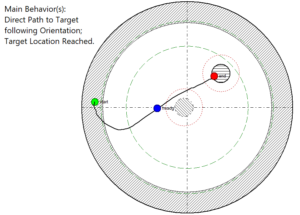
Direct Path Measures and Initial Spatial Intent
In hidden-target Morris water maze tasks, accurate navigation from different starting positions can provide evidence that the subject has learned and localised the target using spatial relationships between environmental cues. These measures are therefore particularly relevant to studies of allocentric spatial learning and memory and hippocampal function in both rodent and human virtual Morris water maze research.
Looking specifically at the initial part of the trajectory can reveal spatial knowledge that is not apparent from commmonly used whole-trial measures. A subject may initially navigate accurately towards the learned location but narrowly miss it or subsequently change its behavior. This is especially important in probe trials, where behavior may change after the subject reaches the remembered location and finds that the target is absent, or in cohorts where factors such as fatigue or disengagement affect later behavior.
Direct Path to Target
The subject takes a near-direct route to the platform or learned target location with minimal deviation.
Direct Path to Target after Initial Orientation
The subject makes a brief initial orientation movement and then takes a direct route to the target. This can include the turning movement made when a subject begins facing the pool wall or virtual boundary before heading towards the target.
Direct Path to Target after Leaving the Wall
The subject initially remains close to the pool wall or virtual boundary, then leaves it and makes a direct approach to the target.
Direct Path to Close Encounter
The subject takes a near-direct route to the immediate vicinity of the platform or learned target location with minimal deviation (but does not reach the target during that initial approach).
This can be particularly informative because a narrowly missed target may be followed by substantial additional time and path, making the accuracy of the initial navigation much less apparent from whole-trial latency or path length.
Direct Path to Close Encounter after Initial Orientation
The subject makes a brief initial orientation movement and then takes a direct route to the immediate vicinity of the target (without reaching the target during that initial approach).
Direct Path to Close Encounter after Leaving the Wall
The subject initially remains close to the pool wall or virtual boundary, then leaves it and makes a direct approach to the immediate vicinity of the target (without reaching the target during that initial approach).
Technical definition, methodology and citation:
Baker-Hawthorne Direct Path Measures in Morris Water Maze Analysis
https://doi.org/10.5281/zenodo.21870806
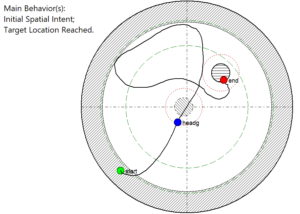
Initial Spatial Intent
The subject’s initial direction of travel is towards the learned target location, whether or not the subsequent trajectory remains target-directed.
This can reveal an appropriate early spatial response even when the subject later deviates, changes its search behaviour or, in a probe trial, redirects its behaviour after the expected target is not found.
Direct Path and Initial Spatial Intent classifications can also be applied to previous target positions and other calibrated locations. This can be particularly useful in reversal learning and cue-conflict or dual-strategy trials, where the direction of early navigation towards competing locations may itself be scientifically informative.
Focused Search
The subject spends more than the set threshold amount of time within the immediate area of a specified location. This can identify focused searching around the platform or learned target location, or around other positions in the pool.
When focused search occurs around the platform or learned location, it is identified as Target-Focused Search. In probe trials, this can reveal persistent searching close to the learned location even when the subject does not cross the exact target position or subsequently moves elsewhere (when platform crossings and target-quadrant occupancy may underrepresent the spatial focus of the search). In acquisition trials, it can identify a strong concentration of search around the platform location even when the subject has a long latency and path before reaching it, or doesn’t quite reach it at all.
Focused search around a non-target location is also identified. This can reveal that the subject’s search is spatially concentrated but centred on a location other than the target, for example a previous platform location during reversal learning.
Target-focused search is often seen after partial learning, in probe trials, or in subjects with mild hippocampal impairment:
- May suggest platform-location memory, but with less specific spatial knowledge than subjects who reach the target, or less efficient path planning than indicated by direct paths.
- May represent imprecise cue integration.
- Has a more precise focus on the immediate surrounding area than ‘target scanning’ (see below).
Scanning
The subject repeatedly passes through or across the immediate area surrounding a specified location, returning to that area more than the set threshold number of times. Scanning can be identified around the platform or learned target location, or around other positions in the pool.
When centred on the platform or learned location, this is identified as Target Scanning. Compared with Target-Focused Search, Target Scanning represents repeated searching through and around the target area rather than sustained occupancy within a more tightly focused area. It may identify intermediate stages of spatial learning and that strategy refinement may be in progress.
Scanning of a non-target location can identify repeated searching around an alternative location, including a previously learned platform position during reversal trials.
Together, Focused Search and Scanning help distinguish where and how the subjects’ searches are concentrated, rather than simply whether they reach the correct location or how far they are from the target on average during the trial. This can reveal focused or repeated searching at the learned target, previous target locations, or other positions of experimental interest.
Chaining
The animal swims in a circular path at a fixed distance from the wall, corresponding roughly to the platform’s radial distance. It looks adaptive (the platform can be found reliably, when present) but it’s not a spatial strategy. Curved passes through the chaining annulus are excluded if not part of actual chaining behavior. The total qualifying angular span is given alongside the identification.
Chaining is common in subjects with hippocampal dysfunction, early in training, or when spatial cues are absent or ambiguous.
In aquisition trials, chaining may suggest that the subject may have a partially developed spatial map, or that a procedural strategy is being used.
If seen in probe trials, chaining suggests:
- A non-spatial, procedural strategy – the strategy allows the platform to be found, when present, by covering all points at the learned distance from the poolside, not via spatial memory.
- Egocentric navigation, possibly mediated by the dorsolateral striatum.
Broad or Uniform Spatial Coverage
The subject covers all parts of the pool without consistent focus on any specific area.
Broad or uniform spatial coverage may be seen during strategy formation and in disoriented or disengaged behavior.
- Suggests the subject is searching randomly or employing a non-specific strategy.
- May reflect uncertainty, early training, or cognitive impairment.
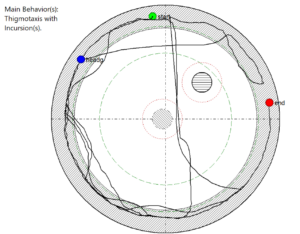
Thigmotaxis
The subject swims along the edge of the pool, hugging the wall. Only actual thigmotactic behavior is identified as thigmotaxis, and the total qualifying angular span is given; other behaviors that result in time or path in the thigmotaxis zone, such as repeated pool crosings (‘bouncing off the walls’) or staying still at the edge, are excluded.
Excessive thigmotaxis can mask or delay spatial learning and is a key behavioral marker to track, particularly in anxiety or neuromodulation studies:
- Common in very early training trials before learning begins, as a natural protective behavior on initial exposure.
- Often said to indicate anxiety, stress, or lack of task engagement if it continues in later trials.
Thigmotaxis with Incursions and Thigmotaxis with Exploration are also identified. These reflect the subject beiginning to move away from the wall and may occur before more extensive searching of the inner parts of the pool.
Inactivity
The subject moves very slowly, or not at all, for much of the trial. Inactivity is identified if movement was below a set speed threshold for more than a set percentage of the trial. The percentage time inactive is given.
A significant proportion of inactivity or floating may be a sign of disengagement, confusion, sensory or motor impairment, or fatigue.
See https://doi.org/10.5281/zenodo.21797205 for further details about the Inactivity measure.
Note: While others have attempted to identify behavior by analyzing path plot images, that overlooks periods of inactivity and differences in speed at different points in the trial; HVS Image uses position data over time, to give accurate identification of behaviors.
Take a look at the detailed Morris water maze analyses that complement the automatic behavior identification.