
The following behaviors and strategies are automatically identified by the HVS Image systems for both rodent water maze and human virtual reality water maze. Both also provide you with detailed analyses and raw data.
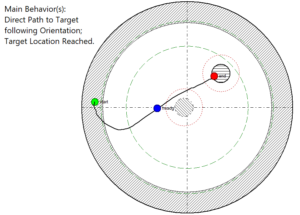
Direct Path to Target: The subject goes straight to the platform or learned location with minimal deviation. A loop or curved path frequently precedes the direct path, as subjects who start facing the poolside turn away from the wall before heading towards the target. This is identified as Direct Path to Target following Orientation.
These behaviors typically emerges in later acquisition trials or well-trained subjects, and suggests hippocampus-dependent learning. It indicates:
- Strong spatial memory.
- Accurate allocentric navigation using distal cues.
- Formation of a stable spatial representation of the environment.
Direct Path to Close Encounter: The subject goes straight to the immediate vicinity of the platform or learned location with minimal deviation, passing through the close encounter circle, but just misses the target position. As a result the latency and path length will be relatively long in comparison to a completely accurate direct path, and will not accurately reflect spatial learning and memory.
See https://doi.org/10.5281/zenodo.21870806 for further details of the direct path family.
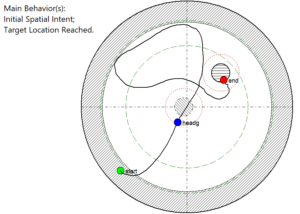
Initial Spatial Intent: The subject initially heads towards the target but may or may not reach it due to distraction, fatigue or other factors, or may closely miss the target on the first attempt and then return to it. If the subject does not reach the target on the first approach, the latency and path length will consequently be relatively long and will not accurately reflect spatial learning and memory.
Initial spatial intent may occur alone or together with direct path classifications. A direct path indicates that the initial spatial intent was maintained through an efficient approach to the platform or its close encounter zone.
Target-Focused Search: The subject spends more than the set threshold amount of time in the immediate area of the platform or target. In probe trials, this identifies subjects persistently searching the target area, even if they don’t cross the exact target location or if they subsequently move on and do not spend a large proportion of time in the target quadrant. In acquisition trials, this identifies learning of the platform location even when the subject has a long latency due to moving very slowly, or does not quite reach the platform itself.
Target-focused search is often seen after partial learning, in probe trials, or in subjects with mild hippocampal impairment:
- Indicates platform-location memory, but with less specific spatial knowledge or less efficient path planning than indicated by ‘direct path to target’.
- May represent slight uncertainty or imprecise cue integration.
- Has a more precise focus on the immediate surrounding area of the platform than ‘target scanning’ (see below).
Target Scanning: The subject spends time near the platform location, passing the target, returning and passing again, crossing the immediate area around the platform more than the set threshold number of times.
Target scanning may identify intermediate stages of spatial learning. It suggests that strategy refinement may be in progress.
Chaining: The animal swims in a circular path at a fixed distance from the wall, corresponding roughly to the platform’s radial distance. It looks adaptive (the platform can be found reliably, when present) but it’s not a spatial strategy.
Chaining is common in subjects with hippocampal dysfunction, early in training, or when spatial cues are absent or ambiguous.
In aquisition trials, chaining may suggest that the subject may have a partially developed spatial map, or that a procedural strategy is being used.
If seen in probe trials, chaining suggests:
- A non-spatial, procedural strategy – the strategy allows the platform to be found by covering all points at the learned distance from the poolside, not via spatial memory.
- Egocentric navigation, possibly mediated by the dorsolateral striatum.
Broad Spatial Coverage: The subject covers all parts of the pool without consistent focus on any specific area (unlike target scanning, which is concentrated near the platform location).
Broad spatial coverage may be seen during strategy formation and in disoriented or disengaged behavior.
- Suggests the subject is searching randomly or employing a non-specific strategy.
- May reflect uncertainty, early training, or cognitive impairment.
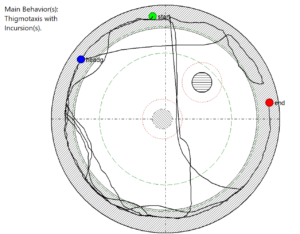
Thigmotaxis: The subject swims along the edge of the pool, hugging the wall. Only actual thigmotactic behavior is identified as thigmotaxis; other behaviors that result in time or path in the thigmotaxis zone, such as repeated pool crosings (‘bouncing off the walls’) or staying still at the edge, are excluded.
Excessive thigmotaxis can mask or delay spatial learning and is a key behavioral marker to track, particularly in anxiety or neuromodulation studies:
- Often indicates anxiety, stress, or lack of task engagement.
- Also common in very early training trials before learning begins, as a natural protective behavior on initial exposure.
Thigmotaxis with Incursions and Thigmotaxis with Exploration are also identified.
Inactivity: The subject moves very slowly, or not at all, for much of the trial.
A significant proportion of inactivity or floating may be a sign of disengagement, confusion, sensory or motor impairment, or fatigue.
See https://doi.org/10.5281/zenodo.21797205 for further details about the Inactivity measure.
Note: While others have attempted to identify behavior by analyzing path plot images, that overlooks periods of inactivity and differences in speed at different points in the trial; HVS Image uses position data over time, to give accurate identification of behaviors.
Take a look at the detailed Morris water maze analyses that complement the automatic behavior identification.